
Introduction: A still figure with a powerful story
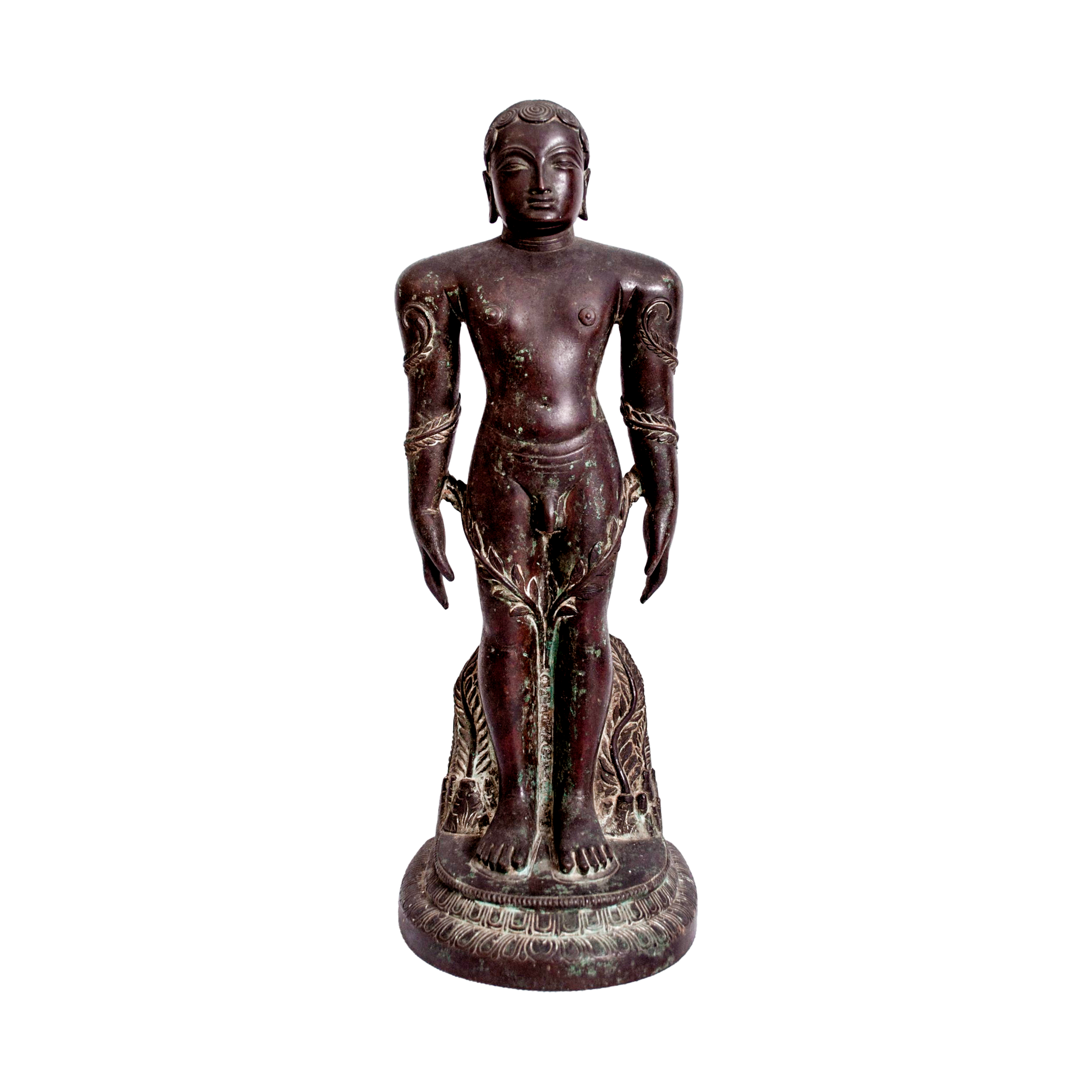
At first glance, this small bronze looks serenely simple: a nude figure standing perfectly upright, vines curling up his legs, feet planted firmly on a lotus base. Look closer, and you discover Bahubali, one of Jainism’s most revered heroes – and a powerful example of how a single work of art can carry centuries of faith, legend, craftsmanship, and family history.
This particular bronze of Bahubali now lives at The Treasure House, my gallery and valuation practice, but its journey began long before me. It embodies not only the Jain ideals of non‑violence and renunciation, but also three generations of my family’s work with Asian art and antiques.
The legend of Bahubali
Bahubali is a heroic figure in Jain tradition, known as the son of the first Jain tirthankara, Rishabhanatha. As the story goes, a bitter dispute for the kingdom arose between Bahubali and his elder brother Bharata. Rather than engage in a full‑scale war that would cost countless lives, they agreed to a series of single combats – eye‑to‑eye contests of strength, without involving their armies.
In the final contest Bahubali gained the upper hand and stood on the brink of killing Bharata. At that moment of victory, however, he experienced profound remorse. Realising the futility of power and the karmic weight of violence, he renounced the throne, laid aside the instruments of war, and turned toward the spiritual path.
Bahubali then embraced the strict ascetic discipline of Jainism. He chose the kayotsarga, or “body‑abandonment,” posture, standing utterly motionless in meditation. According to tradition he remained so still and detached from his body that creeping plants slowly grew around his legs and arms, and birds came to nest in his hair. In this state of unwavering concentration, he ultimately attained moksha – complete liberation from the cycle of birth and rebirth.
Through this story Bahubali becomes an embodiment of ahimsa (non‑violence), humility, and the possibility of radical transformation: a warrior who walks away from conquest to seek inner freedom.
Reading the sculpture: posture, nudity, and vines
When we read a Bahubali sculpture, every element has meaning. This bronze figure stands in the classic kayotsarga pose: the legs slightly apart, knees straight, arms hanging stiffly by the sides, hands relaxed but not engaged in any gesture. The body is upright and balanced, conveying both physical discipline and mental stillness.
The figure is nude, following the Digambara Jain tradition in which nudity symbolises absolute renunciation. Nothing covers the body because the ascetic has given up all possessions, status, and social identity. The simplicity of the form – with no jewelry, weapons, or royal attributes – reinforces Bahubali’s break from his princely past.
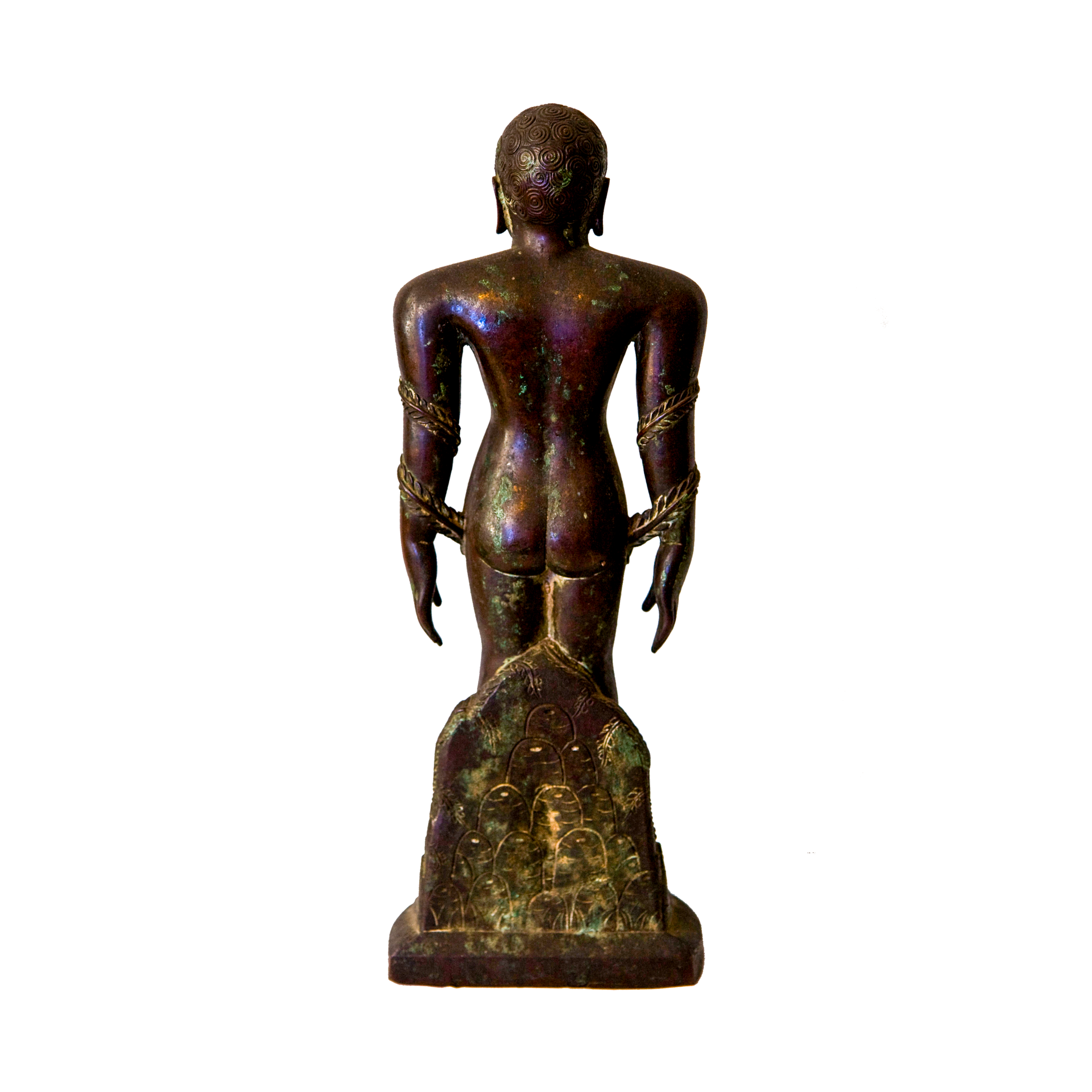
Perhaps the most distinctive feature is the network of vines rising up from the base. They climb along the legs and may wrap around the arms or torso, suggesting the long duration of his meditation in the forest. The sculpture captures the paradox at the heart of the legend: a once‑mighty prince who becomes so still and harmless that nature itself embraces him.
Around the feet you may notice further details: a stylised lotus base, dense foliage, and occasionally small donor or attendant figures. These elements not only enrich the composition but also help scholars determine where and when the bronze was cast, since different regions and periods favoured particular base shapes and decorative patterns.
A wider tradition: from portable bronzes to colossal stone
This bronze belongs to a wider iconographic tradition that stretches across India and through many centuries. Some of the most famous depictions of Bahubali are colossal stone images, such as the monumental statue at Shravanabelagola in Karnataka, carved in the 10th century. There, too, Bahubali stands nude in kayotsarga, with vines carved along his legs and a serene expression gazing into eternity.
Portable metal icons like this one translate the same sacred image into a more intimate scale. They were used in temples, shrines, and private worship, allowing devotees to bring the presence of Bahubali into daily ritual. Despite their smaller size, the best bronzes retain a powerful sense of calm and presence, achieved through subtle modelling of the body, balanced proportions, and careful attention to the flow of the vines and drapery‑like contours.
Dating and regional context of Bahubali bronzes
Precise dating of Jain bronzes requires close study of stylistic features, casting techniques, inscriptions, and comparisons with securely dated examples in museum collections. Features such as the shape of the lotus base, the treatment of the hair curls, the stylisation of the vines, and any script on the pedestal can indicate a particular regional school and approximate period.
Many known Bahubali bronzes come from southern and western India, including Karnataka and Gujarat, where Jain communities have flourished for centuries. These regions developed sophisticated traditions of bronze casting, often associated with temple endowments and private devotional commissions. Within that broad context, each piece has its own story of commission, worship, and eventual movement into the art market.
While it is tempting to fix an exact date, responsible scholarship balances enthusiasm with caution. In my practice, I prefer to share a well‑reasoned range and explain the features that support that view, rather than making emphatic claims that outstrip the evidence. Detailed attribution is a key part of the valuation work we offer at The Treasure House.
A family legacy: from Fremantle to Colombo
For me, this Bahubali bronze is not just an object of study; it is a family heirloom. I inherited this piece from my late father, Mahinda Dharmapala, a world‑renowned antique dealer whose eye and integrity shaped the collections of clients across continents. He ran The Treasure Trove in Fremantle, Perth, Australia, and The Treasure House in Colombo, Sri Lanka, building a reputation for quality, authenticity, and deep knowledge of Asian art.
After my father’s passing, my mother, Kumarie Dharmapala, stepped in and carried the business forward with remarkable dedication for twenty years. She maintained the same standards he set, continuing to source, research, and place important works of art with new custodians. Her stewardship ensured that The Treasure House remained not just a shop, but a trusted institution.
Growing up in this environment, surrounded by objects, catalogues, collectors, and curators, I learned very early that every piece has a story. This Bahubali stood in our family spaces long before I took responsibility for it. It reminds me daily that behind every object passing through my hands is a chain of faith, craftsmanship, and human care.
About me: Sidath Dharmapala, third‑generation dealer
I am Sidath Dharmapala, a third‑generation antique dealer and collector. From my earliest memories I have been surrounded by antiques – bronzes, stone sculptures, temple fragments, colonial and indigenous furniture, silver, ceramics, and more. My childhood was spent in the back rooms of galleries, at markets, in auction rooms, and in conversations with collectors, monks, scholars, and restorers.
Over the years I have developed a particular expertise in South and Southeast Asian bronzes and in antique furniture. I study not only the aesthetics of these objects, but also their metallurgy, casting methods, iconography, and historical context. I pay close attention to condition, authenticity, and provenance – the elements that matter most both to collectors and to museums.
This Bahubali bronze encapsulates that experience. It demands knowledge of Jain iconography, familiarity with regional casting traditions, and sensitivity to the ethics of handling sacred material. It also embodies my responsibility to continue my parents’ legacy at The Treasure House: bringing together connoisseurship, scholarship, and respect for cultural heritage.
What collectors and owners should know about Jain bronzes
For collectors and owners, a Jain bronze like Bahubali raises several important considerations:
- Artistic and spiritual significance
Bahubali images are powerful expressions of Jain ideals: non‑violence, detachment, and the possibility of liberation through discipline. Collectors are often drawn to these works as much for their spiritual resonance as for their sculptural beauty. - Rarity and desirability
While Jain art has been produced over many centuries, fine bronzes in good condition, with honest patina and clear iconography, are relatively scarce. Pieces that retain their base, vines, and original surface are especially sought after. - Condition and restoration
Many older bronzes show signs of ritual use: rubbing on the chest or feet, traces of oil or pigment, and natural wear. These signs are not flaws; they are part of the object’s life. More concerning are aggressive modern cleanings, harsh polishing that removes surface detail, or poorly executed repairs. Understanding the difference is crucial to proper valuation. - Provenance and legality
In today’s climate, the provenance of religious sculptures is of paramount importance. Responsible dealers and collectors ensure that works were exported legally and that their ownership history is documented as far back as possible. At The Treasure House, I treat provenance research as an integral part of both buying and selling. - Valuation factors
The value of a Jain bronze depends on age, quality of casting and modelling, size, iconographic clarity, condition, provenance, and current market demand. Two pieces of similar size can differ greatly in value depending on these factors, which is why professional assessment is essential.
How The Treasure House approaches research and valuation
At The Treasure House, I approach each object – whether a Jain bronze, a Sri Lankan chest, or a Dutch colonial cabinet – with the same three‑part process:
- Research
I first identify the object carefully: subject, region, school, and likely period. For works like this Bahubali, that means studying stylistic details, comparing with documented examples, and consulting relevant scholarship. - Condition and authenticity assessment
I examine the casting, joins, wear patterns, and patina, looking for clues to age and later intervention. I am candid about repairs or uncertain elements; transparency protects both buyer and seller. - Market positioning and valuation
Finally, I consider how similar objects have performed at auction and in private sales, adjusting for differences in quality, condition, and provenance. From there, I can advise on insurance value, fair market value, or retail pricing, depending on the client’s needs.
This methodology applies equally to pieces I offer for sale and to items that clients bring to me solely for advice or valuation.
Invitation to collectors, heirs, and curious owners
If you own a South or Southeast Asian bronze, a Jain sculpture, or an interesting piece of antique furniture and would like to understand it better, I would be pleased to look at it. Whether it has been in your family for generations or recently acquired, a careful study can reveal far more than surface impressions – sometimes confirming long‑held stories, sometimes gently correcting them, and often adding new layers of meaning.
Through The Treasure House, I offer confidential valuations, collection advice, and where appropriate, assistance with sale or acquisition. You are welcome to contact me with photographs and measurements, or to arrange an appointment to bring the object in person.
Just as this Bahubali bronze has passed from my father to me, I see every object as part of a longer journey. My role is to help you understand where your piece sits in that journey – historically, artistically, and in today’s market – so that you can care for it, enjoy it, and, when the time comes, pass it on with knowledge and confidence.
All images and text © The Treasure House Group / Sidath Dharmapala. Please do not reproduce without permission.
